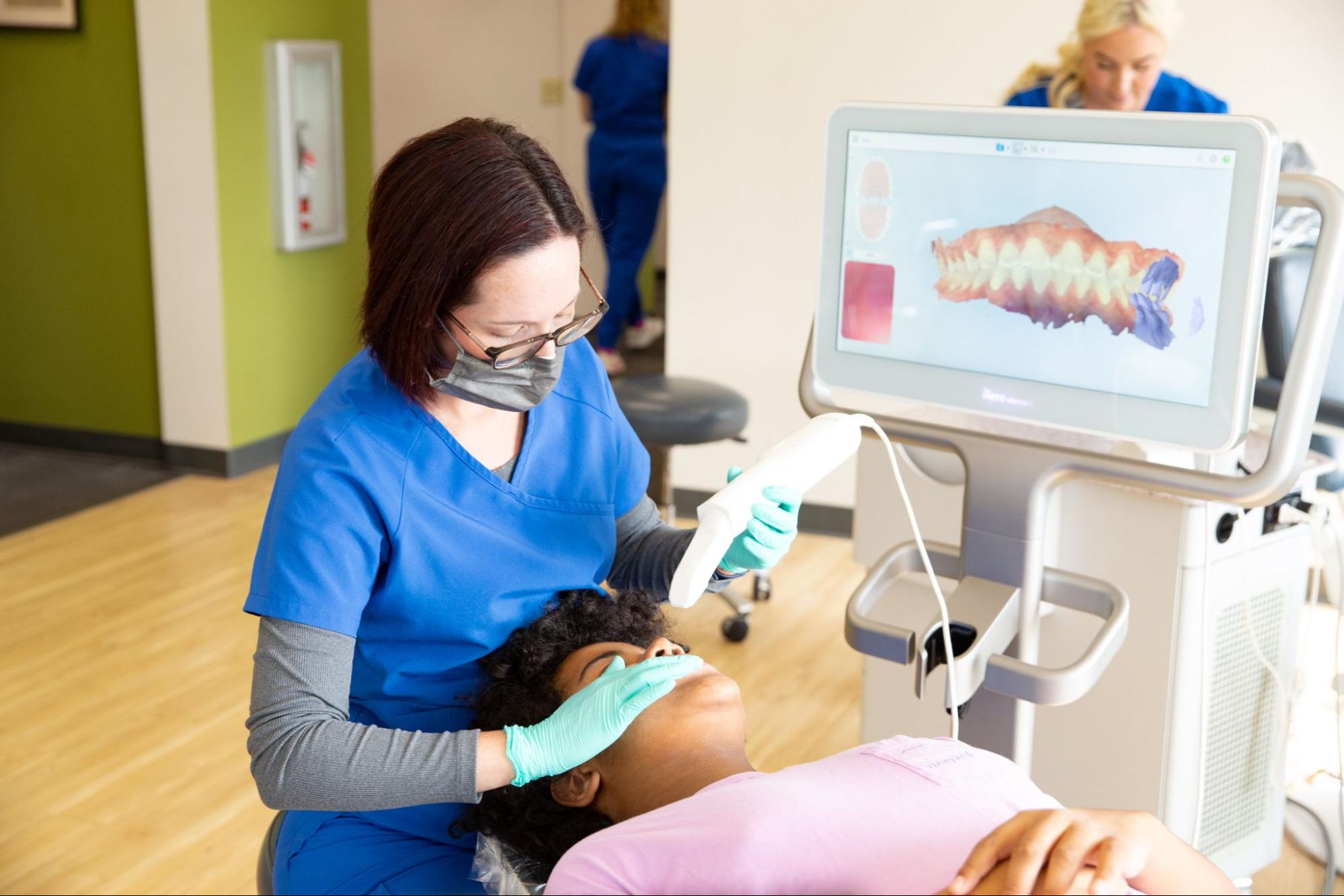
If you’re getting braces or clear aligners, your first visit will likely include a quick, comfortable step that’s changed orthodontics for the better. Digital scans for braces and aligners replace the old putty molds with a small handheld wand and a 3D image on a screen. No goo. No gagging. Just a few minutes of easy scanning.
At CMOA, we use digital scans for nearly every treatment plan, from Invisalign to metal braces to retainers. Here’s exactly what to expect, how it works, and why it matters for your smile.
What Is a Digital Dental Scan?
A digital dental scan is a fast, touch-free way to capture a precise 3D model of your teeth and gums using a handheld intraoral scanner. The wand glides around your mouth and takes thousands of images per second, which software stitches together into a micron-accurate digital model. There’s no putty, no tray, and no waiting for impressions to set.
These digital impressions replace the old-school molds for both braces and clear aligner planning. The 3D dental scan gives Dr. Giarrusso or Dr. Livanos a crystal-clear view of your bite, your tooth position, and your gum line, all in real time. That means better planning and better-fitting appliances from day one.
At Central Massachusetts Orthodontic Associates, digital scanning is standard for every patient who needs one. Both Dr. Lisa M. Giarrusso and Dr. Gregory Livanos bring years of orthodontic expertise to every treatment plan, and we rely on this technology to design care that fits you and your family.
How the Digital Scan Process Works, Step by Step
Wondering what actually happens when you sit in the chair? The intraoral scanner process is quick and easy. Here’s how a digital scan typically goes at CMOA:
- Check-in and brief exam. A team member greets you, reviews your records, and does a quick look inside your mouth to make sure everything’s ready for the scan.
- Scanner wand glides around your arches. Your clinician gently moves the small wand along your upper and lower teeth. You can swallow, talk, and breathe normally the entire time.
- A real-time 3D model appears on screen. As the wand captures images, you’ll watch your smile build up in full color, right in front of you. It’s actually pretty cool to see.
- Bite scan captures how your teeth come together. You’ll bite down naturally while the wand scans from the side. This shows exactly how your upper and lower teeth meet.
- Files are sent to the lab or treatment planning software. For an Invisalign scan, your data goes straight to the aligner lab. For braces, it goes into our planning system.
- Your orthodontist reviews and builds your plan. Dr. Giarrusso or Dr. Livanos studies the model, maps out tooth movement, and designs treatment just for you.
Most scans take about 5 to 10 minutes. No numbing, no discomfort, no mess.
Benefits of Digital Scans for Braces and Aligners
Why have digital impressions become the standard? Because they make life easier for you and more precise for your orthodontist. Here are the benefits you’ll notice most.
Are Digital Scans More Comfortable Than Putty Molds?
Yes, by a wide margin. The scanner wand is small, smooth, and completely dry. There’s no gag reflex, no messy putty, and no bulky trays wedged into your mouth. If you’ve ever had traditional molds taken, you’ll appreciate this comfort factor immediately. Patients who struggle with a sensitive gag reflex often tell us the scan was the easiest part of their visit.
How Much Faster Are Digital Scans?
A full scan wraps up in 5 to 10 minutes. Putty impressions can take 15 to 20 minutes plus curing time. That shorter chair time adds up, especially for families coordinating multiple visits around school and work schedules. Quicker appointments also mean less fidgeting for younger patients who have a hard time sitting still.
How Accurate Is the Technology?
Digital models are precise down to microns, which means better-fitting aligners, brackets, and retainers. That micron-level accuracy also helps your orthodontist plan tooth movement with greater confidence. Better data up front leads to smoother treatment and fewer adjustments along the way.
Can I See My Teeth in 3D?
Yes. You can see your teeth on screen the moment the scan finishes, and for many patients the software can show a simulated preview of expected results before treatment even begins. It’s a fun, motivating way to understand what’s possible. Watching your smile rendered in full color on the monitor is often a highlight of the first visit.
How Are My Records Stored?
Your scan is saved securely as a permanent digital file. If you ever need a replacement retainer years down the road, we already have your model on hand. No need to come in for a brand-new impression. That long-term convenience saves time, hassle, and extra visits.
For teens juggling school and sports, and for busy adults, these benefits add up. Shorter visits. Better fits. Fewer redos.

Digital Scans vs. Traditional Impressions
Both methods can capture the shape of your teeth, but the experience is very different. Here’s a side-by-side look at digital vs. traditional impressions:
| Feature | Digital Scan | Traditional Impression |
|---|---|---|
| Comfort | Small wand, no material in mouth | Putty-filled tray held in place |
| Accuracy | Micron-level precision | Millimeter-level precision |
| Time | 5–10 minutes | 15–20 minutes plus curing |
| Redos | Instant rescan of one area | Full re-impression required |
| Records | Secure digital files, stored long-term | Physical stone models, can degrade |
| Gag reflex | Rarely an issue | Commonly triggered |
Traditional impressions still have their place in rare cases, and they’re a valid method. But for most patients, a 3D dental scan is now the standard of care because it’s faster, more accurate, and far more comfortable.
The biggest practical win? If something doesn’t capture perfectly, your clinician can rescan a small section in seconds. With putty, you start the whole thing over.
Who Is a Good Candidate for Digital Scanning?
Almost everyone is a great candidate for digital scanning. If you can sit in a dental chair and open your mouth, you can likely have a digital scan done comfortably. Here’s who benefits most:
- Kids, teens, and adults starting any kind of braces or aligner treatment. Age isn’t a barrier.
- Patients with a strong gag reflex. No putty in the back of your throat means no gagging.
- Anyone with dental anxiety. The quick, quiet process is easier on nervous patients.
- Invisalign and clear aligner patients. Digital scans are required for aligner fabrication.
- Metal braces and clear braces patients. Digital models help with bracket placement and planning.
- Retainer patients. Scans make it easy to produce accurate retainers and replacements.
In a very small number of cases, like patients with extensive restorative needs or specific clinical situations, a traditional impression might still be the better choice. Dr. Giarrusso or Dr. Livanos will let you know if that applies to you.
Frequently Asked Questions About Digital Scans
Does a digital scan hurt?
No. A digital scan is completely comfortable. The scanner wand doesn’t touch your teeth with any pressure, and there’s no material placed in your mouth. Most patients say it feels like nothing at all, just a small wand moving around while they sit comfortably.
How long does a digital scan take?
A full upper and lower digital scan usually takes about 5 to 10 minutes from start to finish. That includes the bite scan. Compare that to traditional putty impressions, which can take 15 to 20 minutes plus the time waiting for the material to set.
Are digital scans safe for children?
Yes. Digital scans are very safe for kids and teens because they use light and optical imaging, not radiation. There’s no exposure to anything invasive, and the small wand is easy for younger patients to tolerate. Many children actually enjoy watching their teeth appear on the screen.
How accurate are digital scans compared to putty molds?
Digital scans are significantly more accurate than traditional putty impressions. They capture detail down to the micron level, while putty molds measure in millimeters. That extra precision means better-fitting braces, aligners, and retainers.
Will I see a preview of my new smile?
In most cases, yes. Many digital scanners include simulation software that shows a preview of your expected results before treatment starts. It’s one of the most exciting parts of the first visit, and it helps you understand what your smile could look like.
What happens if the scan needs to be redone?
If any part of the scan doesn’t capture perfectly, your clinician can rescan just that section in a few seconds. There’s no need to start over or deal with messy materials again. It’s one of the biggest practical advantages over traditional impressions.
Curious to see your smile in 3D? CMOA offers free consultations where Dr. Giarrusso or Dr. Livanos can walk you through digital scanning and your options. Reach out through our contact page whenever you’re ready to learn more about starting your beautiful smile. Looking for an orthodontist in Worcester, MA? We’d love to meet you.